


Your Guide to AI Data Centres in Scotland
Scottish Civic Trust has prepared this information guide to help community and civic groups better understand what the recent growth in proposed AI data centres could mean from a civic perspective. The guide also addresses some of the questions that have been raised by organisations and individuals across our network.
This guide does not advocate for or against any individual proposal. Its purpose is to provide accessible and balanced information about AI data centres. This guide also offers information about the planning policy framework in Scotland and opportunities for community engagement in the planning process.
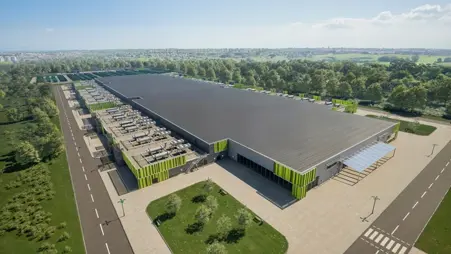
AI data centres have become a major focus of government and private sector investment to provide the infrastructure needed to further develop and deploy artificial intelligence technologies. The UK Government's AI Action Plan includes significant investment in the sector, alongside proposals for AI Growth Zones to accelerate development. Around 100 new data centres are expected across the UK in the coming years, supported by multi-billion-pound investment from major technology companies.
This expansion comes at a time when water scarcity, energy security and the climate emergency are growing concerns. AI facilities can place significant pressure on local resources, particularly through electricity demand and water consumption for cooling. Developers argue that data centres can support economic growth while minimising environmental impacts through renewable energy, battery storage, closed-loop cooling systems and alternative energy sources.
Environmental impacts can also extend beyond energy and water use. New developments can lead to habitat loss and fragmentation, affect freshwater ecosystems, and create noise and light pollution from cooling equipment and associated infrastructure. These impacts can be particularly significant for nocturnal wildlife such as bats, owls and insects.
Prioritising brownfield sites, using non potable water sources, adopting closed loop cooling technologies, incorporating biodiversity data into site selection and improving transparency around environmental performance could help mitigate some of the negative effects.
In Scotland, debate continues over proposals for hyperscale data centres. While the Scottish Government has expressed support for the concept of "green data centres", there does not appear to be a formal definition of what this means in practice. Some stakeholders have called for a moratorium on new developments until the implications for energy demand, infrastructure, local communities and climate targets can be fully assessed.
The key challenge for policymakers is balancing the economic opportunities presented by AI with the environmental, social and infrastructure impacts of large-scale data centre development. As the sector grows, there are increasing calls for clear national standards to define what constitutes a genuinely sustainable or "green" data centre and to ensure that cumulative impacts and community concerns are taken into account and properly considered.
Key Facts
· What is a data Centre?
It’s a physical facility that houses servers, storage systems, networking equipment, and other IT infrastructure used to store, process, and manage data and applications.
· What is an AI data centre?
It is a data centre designed for the demands of artificial intelligence workloads. Unlike traditional data centres, AI data centres are optimized for high intensity tasks such as machine learning, deep learning, and generative AI. They rely on advanced hardware like Graphics Processing Units (GPU), Tensor Processing Units (TPU), and Neural Processing Units (NPU) for faster data processing, analytics, and scalability.
What is a "hyperscale" data centre?
It's a data centre built on a massive scale, designed to store and process huge volumes of digital information for things like AI and cloud services.
Given their size, these facilities need very high amounts of energy and cooling, plus strong connections to the electricity grid and communications networks. They're also built to grow, with more computing power, storage, and infrastructure added as demand increases.
There's no formal definition of "hyperscale" in Scottish planning policy, but the term is generally used to describe facilities housing thousands of servers with at least 900 square metres of floor space and around 100MW of power. In practice, though, most proposals in Scotland go well beyond that minimum, with some stretching across many hectares of land.
· What jobs are being offered by developers?
Building an AI data centre plant could offer work to around 2,000-3,000 construction workers temporarily until the site is completed. Once operational, there may be between 50-100 jobs depending on the size and scale of the data centre and what the developer has set out in their plans. Some companies are promising apprentices for AI researchers, coders and staff who will run and maintain data centres.
· Where are AI Data centres being built in Scotland and why?
The UK is the third largest AI data centre location after the USA and Germany at present. Scotland has been identified as a good location due to the cooler climate and renewable energy. Most of the data centres in Scotland are for the Central Belt area, considered as AI-ready, as connection to established energy networks is considered easier and quicker due to the established connection to the grid already.
· What are Scottish Government regulations and strategy on AI data centres?
The Scottish Government does have information in the National Planning Framework 4 (NFP4) that designates all green data centres of a major scale as part of Annex B – National Developments Statements of Need,
National Development 12: Digital Fibre Network and Data centre planning direction, released 17/08/2026.
This includes AI-focused green data centres meeting the major development criteria. It will be for the planning authority to interpret and apply NPF4 according to the circumstances of each individual case. To be considered a green data centre, planning authorities may wish to consider criteria such as the extent to which the data centre is powered from renewable energy sources; makes use of energy efficient technologies; seeks to minimise water consumption; and supports the re-use of excess heat.
Sources:
- Written question and answer: S6W-41362 | Scottish Parliament Website
- National Planning Framework 4 - gov.scot
- Data centre planning direction - gov.scot
- Questions in the Parliament on Data Centres - Action to Protect Rural Scotland
Frequently Asked Questions:
Is the current AI surge comparable to the Industrial Revolution? What effects will this have long term?
The Industrial Revolution transformed economies from agrarian, labour-intensive systems into machine-driven industries. It increased productivity and wealth, but also contributed to income inequality, poor working conditions, rapid urbanisation, and the decline of many traditional communities.
The rise of artificial intelligence could be considered as a similar technological turning point. AI is already reshaping workplaces, industries, and economies through automation, data-driven decision making, and the expansion of large-scale computing infrastructure. While AI has the potential to enhance productivity and create new opportunities, it also raises concerns about job displacement, privacy, accountability, inequality, and the environmental impact of growing energy demands.
AI data centres require significant amounts of electricity and cooling infrastructure. Some researchers and environmental organisations, such as Action to Protect Rural Scotland (APRS) have raised concerns about their potential impact on energy demand and greenhouse gas emissions.
Research by Laura Veldkamp of Columbia Business School and Simona Abis of the University of Colorado Boulder suggests that AI and big data technologies could reduce labour's share of income by around 5%, a shift comparable to changes seen during the Industrial Revolution. However, the research also highlights AI's potential to boost productivity and create demand for workers with digital and AI-related skills.
Like the Industrial Revolution, AI is unlikely to be simply a story of jobs lost or created. Rather, it could alter how wealth is generated and distributed. The long-term challenge will be ensuring that the economic benefits of AI are shared widely, while supporting workers to adapt to an increasingly technology-driven economy.
· Will the AI data centres be obsolete in 10,20, 30 years?
Over the last few years, there has been an increase in the demand for AI uses. For AI to carry out it’s functions, train and develop further, massive amounts of energy, cooling and land are used for the hyperlink AI data centres needed to meet the rising demands of the ever-increasing AI use we are seeing. As the demand for AI grows, the companies and scientists involved with the development and evolution of how to process and store the data more efficiently and environmentally cleanly, are exploring many options.
One of the potential options that has been looked at since the 1980s was DNA storage. Here is the article regarding this: This ‘Tiny’ Breakthough Could Make AI Data Centers Obsolete and Change Digital Storage Forever
· Why not build them on brownfield or ex industrial land that is already cleared?
Building on greenbelt land, gives developers more flexibility for design and the potential to build larger data centres. Building on brownfield land that used to house industrial sites, may be smaller than the developer might like, but the fact they are normally already connected to the power grid means they can save a lot of time, as the connection is already there, so would be connected easily. The waiting list to be connected to the national grid can mean waiting for years.
· How do you object to planning application?
You can comment, object or approve on any application that comes through the planning process. If you have concerns regarding the local authority’s handling of the application in question, you may wish to raise these directly with the Council’s Chief Executive in the first instance. Where an individual believes they have experienced maladministration, it is open to them to contact the Scottish Public Services Ombudsman.
You may also wish to seek independent planning advice from Planning
Aid Scotland, which offers free and impartial advice to individuals and communities and can be contacted via their website at www.pas.org.uk or by telephone on 0131 220 9730.
Links for further reading:
- New interactive map of hyperscale data centre proposals - Action to Protect Rural Scotland
- https://aprs.scot/press-release/new-interactive-map-of-hyperscale-data-centre-proposals/
- Hyperscale Data Centre Campaigner Day - Action to Protect Rural Scotland
- Scottish data centres powering AI already using enough water to fill 27 million bottles a year - BBC News
- University of Glasgow - Research - Research units A-Z - Centre for Data Science & AI
- Scotland could freeze datacentre projects in challenge to UK’s AI strategy | Scotland | The Guardian
- AI data centres in Scotland - everything you need to know | The Herald
- Does the Rise of AI Compare to the Industrial Revolution? ‘Almost,’ Research Suggests | Columbia Business School
- Data centres in Scotland: a guide to our regulatory role | SEPA